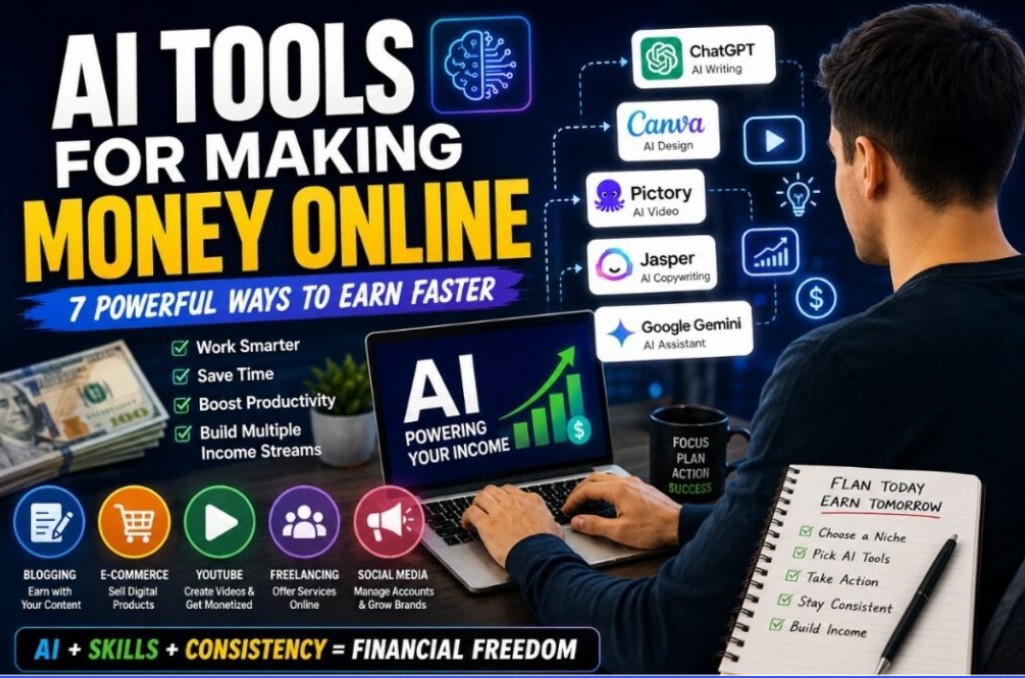
AI tools for making money online can help freelancers, bloggers, designers, video creators, and small business owners complete certain tasks more efficiently. From writing and graphic design to video production and marketing, artificial intelligence can support many types of online work.
However, using AI does not automatically generate income. You still need to develop a useful skill, produce work that meets a real need, and find people willing to pay for the result. The tools are there to assist your work, not replace your judgment, creativity, or responsibility.
In this guide, we explore seven practical ways to use AI tools to pursue online income in 2026. Each method explains what you can offer, how AI can help, how to get started, and what to consider before spending money on software or advertising.
Whether you are a beginner, student, freelancer, content creator, or small business owner, you can start by choosing one method that matches your interests and practising with the tools available to you.
Important: No AI tool or income method can guarantee earnings. Results depend on the quality of your work, customer demand, competition, marketing, and the time you invest in developing your skills.
How AI Tools Can Help You Make Money Online
Artificial intelligence can assist with tasks that traditionally require considerable time, such as brainstorming, drafting, summarising, editing, organising information, and producing initial design concepts. These capabilities can help you deliver certain services more efficiently when combined with human review.
For example, a freelance writer might use an AI assistant to organise research and prepare an initial article outline. A designer might use AI-powered design features to explore different concepts. A video creator might use AI tools to prepare captions or organise a script.
In each case, the person remains responsible for checking accuracy, improving quality, respecting copyright and licensing restrictions, and ensuring the finished work meets the client’s needs.
If you are still deciding which software to learn, explore our guide to the best AI tools for students and businesses. It can help you compare tools according to the type of work you want to do.
How We Evaluate AI Tools for Online Income
At AI Compare Guide, useful recommendations should explain what a tool can do, where it may help, and what limitations readers should consider. For this article, the methods are assessed using practical criteria rather than promises of quick earnings.
- Task suitability: Is the tool appropriate for the work being discussed?
- Ease of use: Can a beginner learn the basic workflow without advanced technical skills?
- Output quality: Does the result require substantial editing, correction, or redesign?
- Human involvement: What expertise, checking, and creative input are still necessary?
- Practical cost: Can someone begin practising with available free features, or might paid access be needed?
- Commercial usefulness: Could the finished work solve a genuine problem for a potential customer?
These criteria help readers evaluate possible uses of AI without assuming that a tool will automatically produce a profitable business. Features, pricing, and usage limits may change, so check the provider’s current information before committing to a subscription.
For more information about our evaluation approach, read How We Test AI Tools at AI Compare Guide.
1. Offer AI-Assisted Freelance Writing Services
Freelance writing is one way to use AI tools for making money online if you enjoy writing, researching, editing, or communicating ideas. Potential services include blog articles, website copy, product descriptions, email newsletters, and social media captions.
AI writing assistants can help you brainstorm topics, organise information, prepare outlines, and improve the clarity of a draft. However, clients need more than text generated by a chatbot. They need accurate, relevant, original work that speaks to their audience and serves a clear purpose.
AI Tools You Can Consider
- ChatGPT: Useful for brainstorming, outlining, drafting, and revising written content.
- Claude: Can assist with long-form drafting, editing, summarising, and organising ideas.
- Grammarly: Can help identify grammar, spelling, and clarity issues in supported writing workflows.
Choose a tool based on the work you intend to offer. You do not need to subscribe to several platforms before you have developed a useful writing skill.
How to Get Started With AI-Assisted Writing
- Choose a service: Start with one specific offering, such as blog writing, product descriptions, or email newsletters.
- Learn the workflow: Practise researching a topic, creating an outline, drafting content, and editing the result.
- Create a sample: Prepare two or three original samples that demonstrate your ability to produce useful, well-organised writing.
- Review every draft: Check factual claims, remove repetition, improve the wording, and add relevant expertise or examples.
- Find potential clients: Build a professional portfolio and approach businesses, publishers, or other potential customers who may need your service.
- Improve through feedback: Learn from client requirements and revise your process to deliver more reliable work.
Example: Creating a Blog Article for a Client
Imagine that a small business needs an informative article explaining how customers can choose a suitable product. You could use an AI assistant to brainstorm questions readers might ask, organise the article structure, and prepare a first draft.
You would then verify the information, remove unsupported claims, add useful examples, improve the writing, and ensure the article answers the customer’s actual question. Your value comes from delivering the finished article, not merely from generating the first draft.
How to Make Your Writing Service More Valuable
Specialising can help you distinguish your service from generic AI-generated writing. For example, you might focus on educational content, product descriptions for online shops, or informative articles for a particular business sector.
Build your portfolio around work you can produce consistently and accurately. Never invent professional experience, testimonials, research findings, or client results to make your service appear more established than it is.
Potential challenge: Competition can be high, and clients may expect research, revisions, originality, and subject knowledge. AI can speed up parts of the process, but it does not remove those responsibilities.
2. Create and Sell Digital Products With AI Assistance
Creating digital products is another possible way to make money online with AI. Depending on your skills and audience, you could develop planners, worksheets, business templates, study resources, checklists, presentations, or original educational materials.
AI tools can help you brainstorm product ideas, organise information, prepare initial text, and develop content structures. Design platforms such as Canva can help you arrange that material into a more usable visual format.
The important step is to create something that solves a specific problem. A collection of generic AI-generated pages may offer little value if it does not help the intended customer accomplish something meaningful.
Digital Products You Could Develop
- Weekly planners and productivity worksheets.
- Social media content calendars for small businesses.
- Editable business document templates.
- Study guides and revision worksheets.
- Original checklists for a particular task or workflow.
- Presentation templates and educational resources.
- Short guides that teach a useful skill.
How to Create Your First Digital Product
- Identify a problem: Find a task that a specific audience wants to complete more easily.
- Define the customer: Decide whether the product is intended for students, freelancers, creators, small businesses, or another group.
- Plan the content: Use AI to brainstorm sections and organise your ideas, then decide what information the product genuinely needs.
- Create the first version: Write the content and use a suitable design tool to create a clear, usable layout.
- Check the product: Correct errors, test links and editable elements, and ensure the instructions are understandable.
- Review permissions: Check the relevant software, asset, font, image, and marketplace terms before distributing or selling the product.
- Prepare the listing: Describe what the customer receives, who it is for, and how it can be used.
- Promote it honestly: Share useful previews and explain the product’s benefits without promising results it cannot guarantee.
Example: A Social Media Content Calendar
Suppose you want to create a content calendar for small businesses. An AI assistant could help brainstorm post ideas and organise them into weekly themes. You could then review the suggestions, adapt them to a particular business type, and build an editable calendar with clear instructions.
The finished product should offer more than a list of generic prompts. It might include content categories, planning columns, caption-writing guidance, and space to track publication dates. Its usefulness would come from how well it helps customers plan their work.

Where Can You Sell Digital Products?
You may sell digital products through a suitable marketplace or your own website. Before choosing a platform, compare its fees, supported payment methods, product rules, and availability in your target market.
Do not assume that uploading a product will automatically generate sales. You may need to improve the product, build an audience, demonstrate its usefulness, and learn which promotional channels reach potential buyers.
Potential challenge: Digital products face competition, and some markets are saturated with similar offerings. Research your intended audience and create a product with a clear purpose before investing heavily in promotion.
3. Create YouTube Content With AI Assistance
Creating YouTube videos is another way to use AI tools for making money online. If you enjoy explaining ideas, storytelling, teaching, or entertaining an audience, AI can help you plan and produce videos more efficiently.
AI tools can assist with brainstorming video topics, organising research, outlining scripts, generating captions, preparing thumbnail concepts, and editing footage. These capabilities can reduce the time spent on certain production tasks, but they do not guarantee views, subscribers, or advertising revenue.
A successful channel still depends on useful content, an identifiable audience, engaging presentation, originality, and consistent improvement. Your goal should be to make videos that people genuinely want to watch rather than simply publishing large amounts of AI-generated material.
AI Tools You Can Use for YouTube Content
- ChatGPT: Can help brainstorm video topics, organise scripts, and develop video outlines.
- Google Gemini: Can assist with brainstorming, summarising information, and planning content.
- Canva: Can help create thumbnail designs, presentations, and supporting visual materials.
- Descript: Offers tools for editing audio and video through supported workflows, including transcript-based editing.
- ElevenLabs: Offers AI voice tools that may support narration and other audio projects, subject to its current features and usage terms.
You do not need all these tools to begin. Start with the capabilities required for your chosen video format, then consider additional software only when it solves a real production problem.
How to Start an AI-Assisted YouTube Channel
- Choose a specific topic: Decide what your channel will help viewers learn, understand, or enjoy.
- Identify your audience: Consider their interests, common questions, and the problems they want to solve.
- Research video ideas: Use AI to brainstorm topics, but check whether the information is accurate and useful.
- Prepare a script: Ask an AI assistant to organise the material into a clear outline, then rewrite and personalise it.
- Create the video: Record yourself, capture your screen, use original visuals, or combine suitable production methods.
- Edit the content: Improve the pacing, sound, captions, transitions, and overall presentation.
- Prepare supporting materials: Create a clear title, an accurate description, and an appropriate thumbnail.
- Publish and evaluate: Study viewer feedback and available analytics to identify areas for improvement.
Example: Producing an Educational Video
Imagine that you want to create a video explaining how beginners can use AI to organise their daily work. You could ask an AI assistant to suggest common challenges, prepare an initial outline, and identify questions your video should answer.
You would then verify the information, add examples, record or produce the video, and edit it for clarity. A screen recording demonstrating a real workflow could make the video more useful than a generic narration accompanied by unrelated stock footage.
Understand YouTube’s Content and Monetisation Rules
Before investing time or money in a YouTube channel, review the platform’s current requirements for monetisation and its rules concerning reused, repetitive, and synthetic content. Using AI does not automatically make a video eligible or ineligible for monetisation; the finished content and the applicable policies matter.
Read the official YouTube Help Center to check the current guidance relevant to your channel and content format.
Be especially careful with copyrighted material, cloned voices, misleading synthetic media, and content that adds little original value. Review the relevant permissions and disclosure requirements before publishing.
How Can a YouTube Channel Generate Income?
Depending on your audience, content, eligibility, and applicable platform rules, a YouTube channel may eventually earn money through advertising, sponsorships, affiliate marketing, memberships, or the sale of relevant products and services.
These options are not guaranteed. A new channel may take considerable time to attract an audience, and some monetisation methods require specific eligibility conditions. Focus first on publishing useful videos and learning what your viewers respond to.
Potential challenge: Video production requires planning, editing, and audience development. AI can assist with parts of the process, but publishing more videos does not automatically lead to more views or income.
4. Offer AI-Assisted Social Media Management
Many businesses need a consistent social media presence but may not have the time or staff to plan and prepare content. If you understand social platforms, communication, and basic content design, you could offer social media management services supported by AI tools.
AI can help generate content ideas, organise posting schedules, prepare caption drafts, suggest campaign themes, and adapt messages for different audiences. You remain responsible for checking the content, maintaining the brand’s voice, and ensuring that every post is suitable for its intended audience.
Services You Could Offer
- Monthly social media content calendars.
- Caption writing and editing.
- Basic graphic design and post layouts.
- Content repurposing for different platforms.
- Campaign brainstorming and planning.
- Simple performance summaries based on available analytics.
You do not have to offer every service. Beginners may find it easier to start with one clearly defined task, such as preparing a weekly content calendar or creating a set of social media graphics.
How to Get Started With Social Media Services
- Choose a type of customer: You might focus on restaurants, local shops, service providers, educators, or another business category.
- Study the audience: Understand what the business offers and what its customers are likely to find useful.
- Create a sample calendar: Plan a week of posts with a sensible mix of educational, promotional, and engaging content.
- Prepare sample designs: Use a design tool to create a few consistent visuals that demonstrate your approach.
- Review everything: Check facts, spelling, tone, image permissions, and the suitability of the proposed posts.
- Build a portfolio: Present your sample work clearly and label fictional demonstrations as samples rather than real client projects.
- Approach potential customers: Explain the specific service you can provide and how it addresses their content needs.
- Agree on deliverables: Clarify the number of posts, revision limits, deadlines, payment arrangements, and who will approve and publish the content.
Example: A Weekly Content Calendar for a Small Business
Suppose a local bakery wants to publish more consistently on social media. You could use AI to brainstorm post ideas, such as product highlights, baking tips, frequently asked questions, and behind-the-scenes content.
You could organise those ideas into a weekly calendar and use a design tool to prepare matching graphics. Before presenting the work, check that product descriptions and prices are accurate, the images are approved for use, and the captions reflect the bakery’s actual offerings.
This approach demonstrates a practical service rather than simply telling a business that you can generate captions with AI.
How to Find Your First Social Media Clients
Begin by preparing a small portfolio that demonstrates your ability to plan and create useful content. You can then approach businesses through appropriate professional channels, personal networks, freelance platforms, or direct enquiries.
Keep your proposal specific. Instead of promising to make a business go viral, explain what you can deliver, how often you can deliver it, and how your service may help the business communicate more consistently with its audience.
Never promise a particular increase in sales, followers, or engagement unless you have reliable evidence to support the claim. Social media results depend on several factors beyond your control.
Potential challenge: Social media management involves more than generating posts. You may need to handle revisions, deadlines, brand guidelines, customer feedback, and performance reporting. Make sure your service description reflects the work you can genuinely deliver.
5. Build an AI-Assisted Blog
Blogging is another option for people interested in using AI tools for making money online. A blog can publish useful information about a particular subject and potentially generate income through advertising, affiliate marketing, sponsorships, or the sale of products and services.
However, a blog is not a guaranteed source of quick income. It takes time to research topics, publish useful articles, attract readers, establish trust, and develop a monetisation strategy. AI can support the production process, but it cannot guarantee search rankings or website traffic.
AI Tools That Can Support Blogging
- ChatGPT: Can help brainstorm topics, organise outlines, and improve drafts.
- Claude: Can assist with drafting, rewriting, summarising, and organising information.
- Google Gemini: Can support brainstorming, research assistance, and content planning.
- Grammarly: Can help review grammar, spelling, and clarity.
These tools have different capabilities and limitations. Verify important facts independently, and do not treat AI-generated references or claims as reliable without checking them.
How to Start an AI-Assisted Blog
- Choose a focused topic: Select a subject you understand or are prepared to research carefully.
- Identify reader needs: Find specific questions or problems your articles can answer.
- Plan useful content: Organise related topics into a sensible publishing plan.
- Prepare an outline: Use AI to organise ideas, identify missing sections, and develop a logical structure.
- Research and write: Verify claims, consult credible sources, and add relevant examples or original analysis.
- Edit the article: Remove repetition, improve clarity, and ensure the content answers the reader’s question.
- Improve the page: Use descriptive headings, useful images, relevant internal links, and an appropriate page title.
- Publish and maintain: Monitor performance, correct errors, and update articles when important information changes.
Example: Turning a Reader’s Question Into a Blog Article
Suppose your blog covers productivity for small businesses. You identify a question such as, “How can a small business organise its weekly social media content?”
An AI assistant could help you brainstorm a useful outline. You would then expand it with practical instructions, realistic examples, limitations, and any relevant research. You might also create an original sample content calendar to help readers apply the advice.
The value comes from solving the reader’s problem. A long article filled with generic AI-generated statements is unlikely to be as useful as a clear, accurate guide that helps someone complete a real task.
How Can a Blog Generate Income?
Once a blog attracts a suitable audience, several monetisation approaches may become possible:
- Display advertising: Earn revenue from eligible advertising programmes, subject to their approval and policies.
- Affiliate marketing: Earn commissions when readers make qualifying purchases through disclosed affiliate links.
- Digital products: Sell relevant templates, guides, or other original resources.
- Services: Use useful articles to demonstrate expertise and attract potential customers.
- Sponsorships: Work with suitable brands when the blog has an audience that matches their needs.
Each option has its own requirements, and income depends on factors such as audience relevance, traffic, trust, conversion rates, and the value of the offer. Publishing an article does not automatically produce advertising revenue or affiliate sales.
Make Originality and Reader Value a Priority
Use AI to assist your thinking and production process, not to publish large quantities of unreviewed material. Check facts, provide useful examples, add original analysis where possible, and ensure each article serves a clear reader need.
If you use AI-generated images, verify that they are appropriate for the page and do not misrepresent fictional interface designs or invented results as genuine evidence. Clearly identify illustrative material when that distinction matters.
For a practical comparison of tools that may support this work, read our guide to 15 AI tools for making money online in 2026.
Potential challenge: Building a blog takes sustained effort. Search visibility, readership, and monetisation can take time, and none is guaranteed. Concentrate on publishing genuinely helpful material rather than chasing a particular word count or publishing frequency.
6. Offer AI-Assisted Marketing Services to Small Businesses
One practical way to use AI tools for making money online is to help small businesses improve their marketing. Many business owners need promotional content, email campaigns, product descriptions, and marketing ideas but may not have the time or skills to create them consistently.
You can use AI to speed up research, organise ideas, and prepare first drafts. Your value comes from understanding the business, checking the information, adapting the content to its customers, and delivering work that supports a clear marketing goal.
Marketing services you can offer
- Email marketing: Draft newsletters, welcome emails, and promotional campaigns.
- Product descriptions: Help online sellers explain product features and benefits clearly.
- Promotional campaigns: Develop campaign ideas, captions, and calls to action.
- Marketing calendars: Organise promotional activities around product launches, holidays, and special offers.
- Customer research summaries: Organise information supplied by clients to identify common customer questions and needs.
How to get started
- Choose a specific business type. You could focus on restaurants, fashion sellers, online shops, tutors, or service providers.
- Identify one marketing problem. For example, a local clothing seller may need better product descriptions and consistent promotional posts.
- Use AI to prepare a draft. Tools such as ChatGPT or Gemini can help you brainstorm campaign ideas, organise information, and draft copy.
- Verify every claim. Confirm prices, product details, delivery terms, and other facts with the client before publishing.
- Create a sample campaign. Prepare a short demonstration showing the business what you can deliver. Clearly label speculative work as a sample.
- Approach potential clients. Contact suitable businesses professionally and explain the specific problem your service can solve.
- Agree on the scope and price. Define the number of deliverables, deadlines, revision limits, and payment terms before starting.
Example: Marketing support for a small bakery
Imagine a bakery that wants more customers for its weekend cake orders. You could use AI to brainstorm campaign themes, draft several social media captions, prepare a short promotional email, and organise a one-week content calendar.
Before delivering the campaign, you would confirm the bakery’s actual prices, available products, ordering deadline, delivery arrangements, and contact details. You would also adjust the wording to match the bakery’s brand and intended customers.
This gives the owner a more organised marketing plan while giving you a service you can offer to other suitable businesses.
AI-assisted small-business marketing
How can you find clients?
Start with businesses whose products or services you understand. You can use professional networking platforms, relevant business communities, freelance marketplaces, or direct outreach where permitted. Instead of simply saying that you use AI, explain the result you can provide, such as a weekly promotional calendar or a set of carefully reviewed product descriptions.
Important: AI-generated marketing content still requires human judgement. Do not promise increased sales, guaranteed customer growth, or specific marketing results unless you have reliable evidence to support those claims.
7. Create and Sell Online Courses or Educational Resources With AI
If you have useful knowledge or a skill that other people want to learn, AI can help you turn that knowledge into an organised educational resource. This may include a short online course, a beginner’s guide, a workbook, a tutorial series, or a downloadable study resource.
However, simply generating a course with AI is unlikely to make it valuable. People need accurate information, clear explanations, practical examples, and a reason to trust the person teaching them. Your experience, research, and quality control are essential.
What can you create?
- Beginner guides to using common digital tools.
- Short courses teaching a practical skill you understand.
- Workbooks and exercises that help learners practise.
- Step-by-step tutorials for a particular task.
- Downloadable checklists, templates, and learning plans.
How to create an educational product with AI
- Choose a specific audience. Decide whether you are helping beginners, students, freelancers, small-business owners, or another clearly defined group.
- Identify a real learning need. Research common questions and problems. Do not assume that people will pay for a topic simply because you find it interesting.
- Plan the lessons. Ask an AI assistant to help organise your topic into logical sections, learning objectives, examples, and exercises.
- Develop the material. Use AI to brainstorm explanations or prepare initial drafts, then add your own knowledge, examples, demonstrations, and practical instructions.
- Check accuracy and originality. Verify factual claims, test any instructions that can be tested, and make sure you have the right to use included images, music, text, and other materials.
- Prepare the learning experience. Use suitable presentation, design, recording, or document tools to make the material easy to follow.
- Get feedback before launching. Ask a small group of suitable learners to review the material and identify unclear sections or missing steps.
- Select a suitable sales channel. Compare available platforms, fees, payment options, audience reach, and applicable rules before choosing where to sell.
Example: A beginner’s guide to AI tools
Suppose you understand how beginners can use AI assistants to research topics, organise projects, and improve their writing. You could develop a short guide with practical exercises and examples showing readers how to complete those tasks responsibly.
An AI assistant could help you arrange the lessons and generate practice questions. You would still need to verify the instructions, demonstrate the steps, remove errors, and ensure that the finished guide provides useful information beyond a collection of generic AI-generated paragraphs.
You could offer the resource as a paid download, use it as part of a course, or provide a free version to introduce people to a related service. Each approach has different costs and income potential.
Developing an educational product with AI
What should you know before selling a course?
Creating the product is only one part of the process. You must also reach potential learners, explain the value of the course, provide appropriate customer support, and keep the material accurate as tools and information change.
A course may make few or no sales, especially when the topic is too broad, the product lacks practical value, or there is little demand. Start with a manageable resource, learn from feedback, and improve it before investing heavily in a larger course.
How to Choose the Right AI Tools for Making Money Online
You do not need every AI application available to begin. The best tools for you depend on the service you want to offer, the quality of your work, your budget, and the needs of your intended customers.
1. Match the tool to the task
Choose tools according to the work you need to complete. A writing assistant may help with outlines and drafts, while a design application may be more suitable for graphics. Video creation, transcription, research, and email marketing may require different capabilities.
2. Check the free plan and total cost
Some applications offer free access with usage limits, while others require a subscription for particular features. Before paying, check current pricing, usage restrictions, export options, and any additional costs involved in delivering work to clients.
3. Review output quality carefully
Test the tool with a realistic task. Check whether the result is accurate, useful, easy to edit, and suitable for your audience. An application that produces impressive demonstrations may still require substantial correction for professional work.
4. Understand commercial-use rights
Read the relevant terms and licensing conditions before using AI-generated text, images, audio, video, or templates in paid work. Check the rights for any third-party material you include, and do not assume that everything generated or downloaded is automatically free of restrictions.
5. Protect client and customer information
Do not upload confidential client documents, personal information, passwords, or sensitive business data to an AI service without appropriate authorisation and a clear understanding of its privacy terms. Use only the information necessary for the task.
6. Keep a human review process
Use AI to assist your work, not to remove responsibility for the final result. Review facts, calculations, spelling, tone, originality, formatting, and any instructions before delivering or publishing content.
For a broader overview of tools that may suit different needs, see our guide to the best AI tools for students and businesses.
A Simple 30-Day Plan to Start Making Money Online With AI
If you are new to using AI tools for making money online, trying to start seven different income methods at once can waste time and money. A more practical approach is to choose one service, learn the necessary skills, create a sample, and test whether people are willing to pay for it.
The following 30-day plan gives you a manageable starting point. Your results will depend on your skills, available time, market demand, and ability to find customers. The timeline is a planning guide, not a promise of income.
Week 1: Choose one method and learn the basics
- Choose one of the seven methods discussed in this article.
- Identify the type of person or business that could benefit from your service or product.
- Select one or two suitable AI tools rather than subscribing to several applications immediately.
- Practise completing realistic tasks and check the quality of the results.
- Review the tools’ pricing, limitations, and commercial-use terms.
Example: If you choose freelance writing, practise creating a clear article outline, improving a draft, checking facts, and editing the final text for a particular audience.
Week 2: Create a useful sample
- Prepare one or two examples that demonstrate the service you want to offer.
- Make sure your samples are original, accurate, and professionally presented.
- Explain what problem each sample solves and who might benefit from it.
- Ask someone in your intended audience to review the work and identify weaknesses.
- Improve the samples based on useful feedback.
Your portfolio does not need to be large. A small collection of relevant, well-prepared examples can be more useful than many rushed pieces of AI-generated content.
Week 3: Find and approach potential customers
- Identify businesses, creators, or individuals who may need your service.
- Use suitable freelance platforms, professional communities, or direct outreach where permitted.
- Write personalised messages that explain how you can help with a specific problem.
- State clearly what you can deliver, the expected timeframe, and your proposed price.
- Keep a simple record of your outreach, responses, and follow-up dates.
Avoid sending the same generic message to hundreds of people. A relevant, respectful approach is more useful than making exaggerated claims about how much money AI can generate.
Week 4: Deliver, learn, and improve
- Agree on the scope of work, payment arrangements, and deadlines before accepting a project.
- Deliver the agreed work and review it carefully before submission.
- Ask the customer for specific feedback.
- Record the time and expenses involved in completing the task.
- Use what you learn to improve your service, pricing, and portfolio.
At the end of the month, assess what happened. Did people respond to your offers? Did they understand the value of your service? Which tasks took too long? What could you improve? Use those answers to decide whether to continue, adjust your approach, or test a different method.
Common Mistakes to Avoid When Using AI to Make Money Online
AI can make some tasks faster, but it does not remove the need for skill, planning, and sound business decisions. Avoiding the following mistakes can help you use your time and money more carefully.
1. Expecting instant or guaranteed income
AI tools do not automatically produce customers, traffic, or sales. Building a service business, blog, YouTube channel, or digital product usually requires consistent work and testing. Be cautious of anyone promising guaranteed earnings from a particular tool or method.
2. Paying for too many subscriptions too early
Start with the smallest set of tools that can complete your chosen tasks. Upgrade only when a paid feature solves a real problem or provides enough value to justify its cost.
3. Publishing unedited AI-generated content
AI outputs may contain incorrect facts, repetitive explanations, unsupported claims, or unnatural language. Review and improve every deliverable. Add relevant experience, reliable information, practical examples, and original analysis rather than publishing generic material without meaningful review.
4. Ignoring the needs of the customer
Customers generally pay for useful outcomes, not simply for the fact that you used AI. Focus on the problem you can solve, the quality of your work, and the experience you provide.
5. Overlooking costs and profitability
Revenue is not the same as profit. Account for subscriptions, platform fees, payment processing, advertising, internet access, revisions, and the time required to complete the work. A service that generates revenue may still be unprofitable if its costs are too high.
6. Ignoring platform rules and intellectual property
Review the rules of any platform where you publish or sell content. Check commercial-use permissions, disclosure requirements, copyright considerations, and restrictions on misleading or repetitive content. Policies can change, so consult the current official guidance before relying on a particular monetisation method.
For publishers who plan to earn through display advertising, review the official Google AdSense Help Centre for current programme guidance and requirements. Using AI does not automatically make a website eligible for advertising approval.
7. Trying to do everything at once
Freelance writing, video creation, blogging, marketing, and course development require different skills. Choose one method, establish a workable process, and expand only when you understand what is working.
Frequently Asked Questions About AI Tools for Making Money Online
1. Can I make money online with AI as a beginner?
Yes, beginners can use AI to support services such as writing, design, content planning, research assistance, and digital product creation. However, you still need to learn the relevant skills, review the output, find customers, and deliver useful work. Beginners should start with a manageable project instead of expecting immediate income.
2. What are the best AI tools for making money online?
The best tools depend on your chosen method. ChatGPT, Claude, and Gemini can assist with writing, research, and planning. Canva can help with visual content, while suitable video-editing applications can support video production. Compare current features, costs, output quality, and commercial-use terms before choosing a tool.
3. Can I make money with AI without investing money?
You may be able to start with free plans, existing skills, and free or low-cost publishing channels. However, free plans often have limits, and you may still need internet access, time, training, or other resources. You do not need to buy multiple subscriptions before testing whether your idea has potential.
4. Which AI side hustle is suitable for beginners?
AI-assisted freelance writing, social media content support, and simple digital products can be reasonable starting points if they match your skills and interests. Choose a method you can practise, demonstrate, and deliver reliably. The most suitable option is not necessarily the one promoted as the fastest or most profitable.
5. Can AI generate passive income?
AI can help you create assets such as blog posts, templates, guides, and educational products that may continue to attract customers or readers over time. However, these assets often require upfront work, promotion, maintenance, and updates. Income is not guaranteed, and many products generate little or no revenue.
6. Do I need coding skills to make money with AI?
No. Many AI-assisted services, including writing, social media planning, graphic design, and digital product creation, can be carried out without programming. Coding may be useful for more technical projects, but it is not a requirement for every AI-related income method.
7. Is AI-generated content enough to make a website profitable?
Not by itself. A website needs to provide genuine value to its intended audience. Useful original information, accurate explanations, a good reader experience, and appropriate monetisation strategies matter. Publishing large quantities of unreviewed, repetitive content does not guarantee search traffic or advertising approval.
8. How long does it take to earn money using AI?
There is no universal timeline. A freelancer may find a client before a new blog attracts meaningful search traffic, while a digital product may take time to develop and promote. Results depend on demand, skill, competition, pricing, and how effectively you reach potential customers. Plan around learning and measurable progress rather than a promised deadline.
Final Thoughts: Start Small and Build With Purpose
AI tools for making money online can help you work more efficiently, explore business ideas, and create useful services or products. From freelance writing and digital products to YouTube content, blogging, marketing support, and online courses, there are several ways to put these tools to practical use.
But the tool itself is not the business. You still need to understand your audience, develop useful skills, check your work, manage costs, and find people who are willing to pay for the value you provide.
If you are just starting, choose one method from this guide. Learn the necessary tools, create a sample, seek feedback, and test the demand before making significant financial commitments. Build on evidence rather than hype.
To explore more options, read our guide to AI tools you can use to explore online income opportunities in 2026. You can also compare tools in our guide to the best AI tools for students and businesses.
The most useful approach is simple: use AI to support your skills, solve a real problem, and keep improving based on what your audience or customers actually need.
Osayamen Okuonghae
AI Researcher | Founder of AICompareGuide.com
Helping professionals and businesses make smarter decisions through
in-depth AI tool comparisons, feature breakdowns, and practical insights
on leading AI assistants like ChatGPT, Gemini, and Claude.